
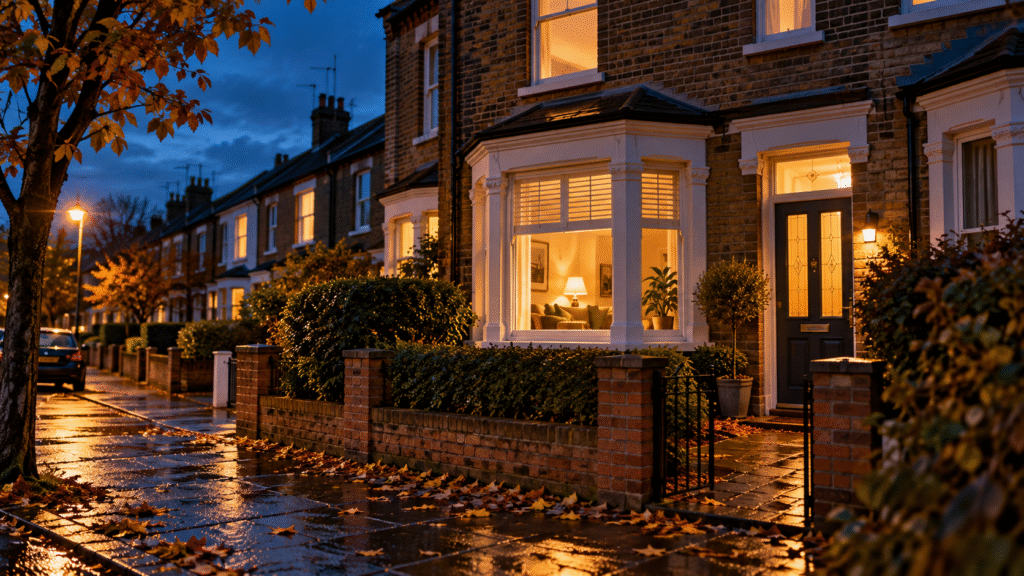

Clocks Go Back Home Security Tips for UK Homes

Clocks Go Back Home Security: How to Protect Your Home on Darker Evenings

Clocks Go Back Home Security: How to Protect Your Home on Darker Evenings

On Sunday 25 October, the clocks go back an hour. Most of us enjoy the extra hour in bed, then notice the change on Monday evening, when it’s dark before we’ve even left work.

It’s easy to assume darker evenings automatically make homes less safe. In reality, darkness itself isn’t the problem. What matters is what your home looks like when it’s dark. That’s what clocks go back home security is really about: a few simple habits that keep your home looking lived-in.

This guide covers why the clocks going back changes how your home appears, where UK homes become more visible on darker evenings, and the easy, no-fuss steps that keep yours looking occupied all winter.

Why Darker Evenings Change How Your Home Looks

When the clocks go back, our routines barely change. We leave for work, do the school run and head to the gym at the same times as in September. The difference is that by late October it’s dark by around 5pm, and earlier still by December.

That means a home that looked occupied at 6pm in summer can look empty at 6pm in winter, simply because the lights are off.

Your routine stays the same, but the light doesn’t

In summer, daylight does a lot of quiet work for you. Open curtains, a car on the drive and natural light all make a home feel lived-in. Once evenings get darker, the clearest signal is whether lights are on inside.

The seasonal picture, in context

It’s worth keeping the risk in proportion. Burglary in England and Wales has fallen significantly over the past two decades (ONS crime statistics). Where it does rise, it’s in the darker months: ONS analysis of police-recorded crime found domestic burglary peaks in the winter quarter (BSIA).

That’s why police forces across the UK run darker nights campaigns every October, and why their advice so often comes back to one thing: using lights, ideally on timers, so your home looks occupied when you’re out.

Where Homes Become More Visible on Darker Evenings

Most homes aren’t any less secure in October than in July. They just become easier to read from the outside. Knowing where that happens makes it simple to put right.

The 4pm to 7pm gap

The hours between sunset and getting home are the most noticeable change. Lights are off, curtains are open and the house is clearly empty. For many working households, this gap is two to three hours every weekday.

Side gates, gardens and outbuildings

Back gardens and side access are quiet and out of sight at the best of times. On darker evenings they’re harder to keep an eye on, especially sheds, garages and bike stores that sit away from the house.

  • Side gates left unlocked after the bins go out
  • Sheds and garages holding tools, bikes or garden equipment
  • Back gardens with no lighting or movement detection

Doors and ground-floor windows

Busy mornings in the dark make it easy to forget a back door or leave a downstairs window on the latch. These small, everyday slips matter more when there’s less light to notice them.

Half-term, Halloween and Bonfire Night

Late October and early November bring a run of busy evenings. Half-term trips, trick-or-treating and fireworks displays mean more homes are empty after dark, often at predictable times. It’s not a reason to stay in, just a reason to set your lights before you head out.

Simple Home Security for Darker Evenings

Good home security on darker evenings doesn’t need complicated systems, apps or subscriptions. A few simple, reliable tools working quietly in the background do most of the job for you.

Light Switch Timer: a lived-in look, set once

The easiest way to close the 4pm to 7pm gap is to have your lights come on before you get home. The Light Switch Timer sits over your existing light switch and physically switches your normal ceiling lights on and off at the times you choose. Your home looks occupied on dark evenings, whether you’re at work, out for the evening or away for half-term.

  • Fits over standard UK rocker switches, with no wiring or electrician needed
  • 7-day programming with up to 9 on/off times a day, plus a random night-time setting
  • No app or Wi-Fi needed

It’s battery-powered, so it keeps running through a power cut, and it’s certified under Secured by Design, the police-backed security initiative. Setting it up for the first time? Our step-by-step programming guide walks you through it in a few minutes.

Motion Alarm: an alert at the doors you don’t watch

Back doors, French doors and garages are where everyday slips happen. The Motion Alarm is a compact, battery-powered sensor with a built-in 125dB alarm. Point it at a back door or the inside of your garage or shed, and it sounds the moment it detects movement, loud enough to startle anyone who shouldn’t be there.

A remote key fob arms and disarms it, and there’s a softer chime mode if you’d simply rather know when someone walks in.

Arctic Air motion detector siren alarm distance and angle

Garden Sensor: know when someone is in the garden

Side gates, driveways and back gardens are the hardest areas to keep an eye on once evenings draw in. The Garden Sensor kit pairs two outdoor motion sensors with a plug-in chime indoors, so you hear the moment someone comes up the drive or through the side gate, even through brick walls.

You can give each sensor its own chime, so you’ll know straight away which part of the garden it came from.

All three work straight out of the box, with no apps, subscriptions or complicated installation.

Quick Wins Before the Clocks Go Back

A few minutes this weekend sets your home up for the whole winter. None of these take long, and most cost nothing.

  • Put your lights on a timer for the rooms visible from the street, set for just before dusk. A Light Switch Timer does this automatically, every day.
  • Check existing timers show the right time after 25 October, and bring ‘on’ times forward to match the earlier dusk.
  • Test outdoor lights and replace any blown bulbs.
  • Lock side gates every evening, including after bin day.
  • Lock sheds and garages, and keep ladders and tools inside.
  • Close curtains when lights come on, so rooms look occupied but private.
  • Keep keys away from doors, letterboxes and cat flaps.
  • Cut back hedges that hide your front door or side access.

A habit that costs nothing

Make locking up part of your evening routine: back door, windows, side gate, shed. Tie it to something you already do, like closing the curtains, and within a week or two it becomes automatic.

Good Home Security Is About Consistency

The clocks going back is a useful reminder, not a reason to worry. Darker evenings simply change what your home looks like from the outside, and a few small habits put that right.

Good home security isn’t about complexity. It’s about consistency. Lights on a timer, doors locked as part of your routine and an eye on the garden do more than any single big change.

Start with your lights, then add cover for the back door and garden as you need it. You’ll find everything in the mydome range, with free UK delivery on orders over £35.

Frequently Asked Questions

When do the clocks go back in the UK in 2026?

The clocks go back one hour at 2am on Sunday 25 October 2026, when British Summer Time ends. They go forward again on the last Sunday of March.

Do burglaries increase when the clocks go back?

Burglary in the UK tends to be higher in the darker autumn and winter months, when it’s easier to tell that a home is empty. Overall, burglary has fallen significantly over the past two decades, and simple steps like lights on timers and locked doors and gates make a real difference.

How can I make my house look lived in on darker evenings?

Put your main lights on a timer so they come on just before dusk, close curtains when the lights are on, and keep outdoor areas lit or monitored. Varying the on and off times through the week makes it look natural.

Is it better to leave lights on or use a timer?

A timer. Leaving lights on all day adds to your energy bill and can look odd in daylight. A timer switches them on at dusk, when it matters, and a battery-powered light switch timer keeps running even during a power cut.

Does a light switch timer work with LED bulbs?

Yes. The mydome Light Switch Timer physically presses your existing switch, so it works with LED, CFL and energy-saving bulbs. It fits standard 1, 2 and 3 gang UK rocker switches, but not dimmer, flat or flush, slimline or 4-gang switches.

How do I secure my garden and shed in winter?

Lock side gates and sheds every evening, store tools and ladders indoors, and use a garden sensor or shed alarm to alert you to movement in areas you can’t easily see from the house.

PLEASE SHARE THIS:

Leave a Comment

Your email address will not be published. Required fields are marked *

This site uses Akismet to reduce spam. Learn how your comment data is processed.

Shopping Basket

Free Shipping On All Orders Over £35

Fast & Free